
A woman named Stella purchased her first Jellycat plush toy in the midst of a period of job loss during the global health crisis. Prompted by an acquaintance's enthusiasm for the British-designed toys, her interest was fully captured upon seeing a distinctive gingerbread cottage design circulating on a popular Chinese social media platform.
Although The Christmas holiday is not widely celebrated in China, serving more as a retail occasion rather than a cultural tradition, the sight of gingerbread houses resonated to Stella. "The festival doesn't mean a lot for me... However, I always like the appearance of those sweet houses," she states. This prompted her to eventually request a friend in Guangzhou to buy the item on her behalf.
That acquisition took place in 2021, coinciding with Jellycat was poised of achieving significant popularity in China and internationally. "People were anxious, and no-one knew what exactly was going to happen," recalls Stella, who developed a routine of stroking and hugging her plushies to cope throughout that stressful time. Residing in Beijing, which experienced some of the strictest lockdowns in the world, she spent extended periods indoors.
Now aged 32 with a new job as a sales manager in the tourism industry, Stella continues to expand her assortment. Her collection has swelled to around 120 items, representing a cost of about 36,000 yuan. "As an adult, you have numerous matters you can't discuss with other people... and the problems we encounter are far more complicated than in the past," she notes reflectively. "The plushies assist me in managing my emotions."
Initially created with kids in mind, these soft toys have transformed into a global sensation, especially within China where an increasingly disenchanted youth demographic has been turning to them for emotional support.
Understanding the Adult Toy Enthusiasts
Stella's Gingerbread house plushie belongs to their "Amuseables" series, a range of characters featuring small expressions inspired by everyday items, ranging from toilet rolls to hard-boiled eggs. These items are considered the "breakout products" which "resonate with a broad Gen-Z and millennial audience" globally, according to industry analysts.
Their growing appeal "could have a connection to a desire for companionship," suggest cultural commentators. It is hard to say for sure whether the launch of the iconic Amuseable line in 2018 was a deliberate strategy to target the young adult market, toy manufacturers are under pressure to must find new markets due to declining birth rates across numerous countries.
The brand entered the Chinese market as early as 2015. By laying the necessary "foundation", the company was able to tap into "the mood of the pandemic"—a time when individuals looked for comfort during widespread anxiety—and built on this success there, according to business consultants.
Jellycat's fame was also boosted through creative temporary events. These retail activations often featured a selection of limited-edition "food" products. Numerous fans record their experience being served and post the clips on social platforms.
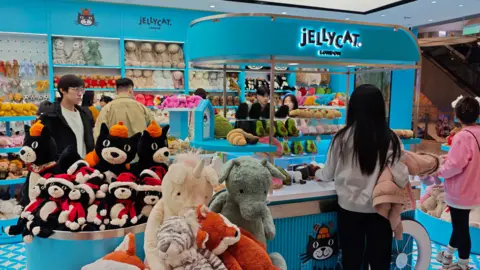
Localisation has also been an essential approach. As an example, customers were able to buy plush interpretations of classic UK dishes like fish and chips at a pop-up in London. Meanwhile, products including teapot and teacup plushies were sold at special stores in Chinese metropolises the previous year.
In 2024, the British company's revenue reportedly rose by two-thirds to reach an impressive sum. In that period, sales of an estimated $117 million in value of its products in China via major online marketplaces, per research data.
This growth mirrors a broader boom in China's collectible toy market among young adults seeking emotional support and community. Total revenue from collectible toys in China are expected to top 110 billion yuan annually, as per a 2024 industry report.
The remarkable success of other toys such as Labubu, elf-inspired figures by domestic company Pop Mart, highlights the market's growing appetite towards designer collectibles. The so-called "adult-child" phenomenon isn't unique to China; young adults globally are starting to question "traditional notions of adulthood," observe cultural experts.

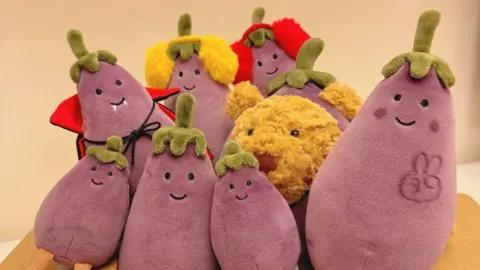
Amuseables, items like the aubergine character—affectionately dubbed "the boss" in China—have also spawned a wave of online jokes, with many expressing grievances regarding adult life. On social media, the "eggplant boss" tag is a space where people sketch various emotive faces on their toy, showing it in different states from drinking to fake-smiling.
For example, a marketing professional from Hong Kong, Wendy Hui, personalized her aubergine toy by drawing dark circles around its eyes and putting spectacles on the toy. She shared an image online captioning it: "The mood of workers on Monday." "I kept working from home even during time off," she explains. "I merely intended to express the level of exhaustion I felt."
In this way, the brand has emerged as a surprising, whimsical channel for China's youth to voice their frustrations about a slowing economy, where hard work doesn't always ensure commensurate rewards. Despite heavy online censorship, digital spaces remains an important, perhaps the primary, arena for such discussions.
Its regular releases of exclusive products coupled with the discontinuation of certain lines—an approach sometimes referred to as "scarcity marketing" in China—has further driven {


